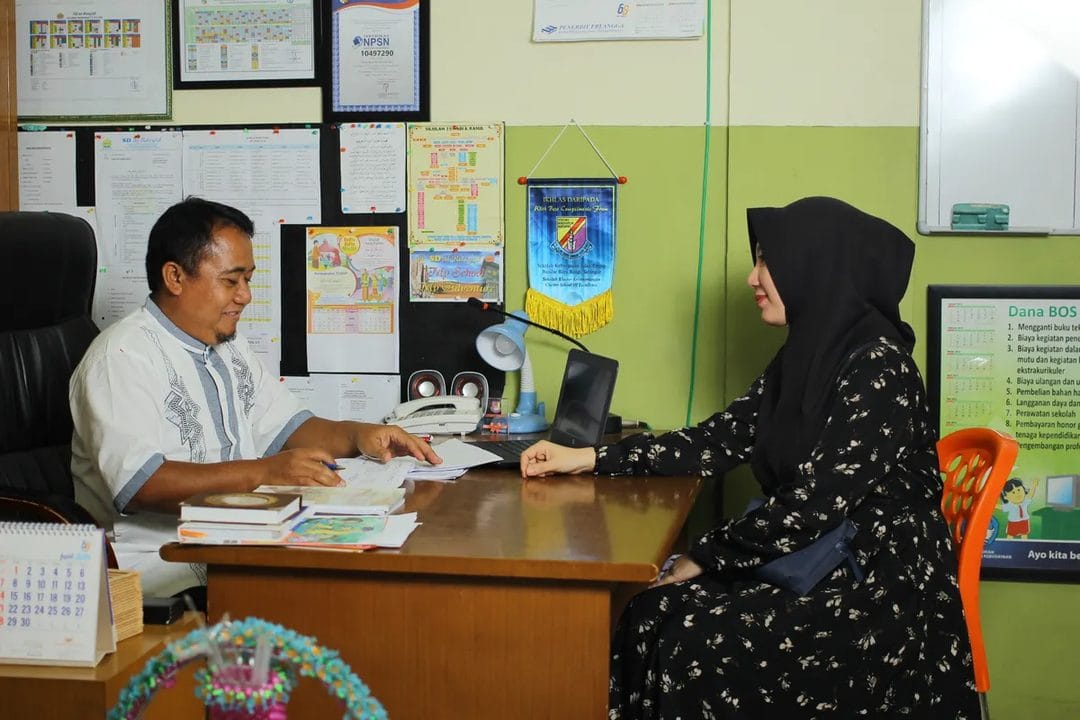
The ten-minute slot is shorter than it looks on the sign-up sheet
Ten minutes. That's roughly what most elementary schools allot per family for a fall parent-teacher conference, and it's rarely a clean ten — the family before you runs two minutes over, the teacher needs a beat to switch gears, and suddenly you've got six or seven minutes of actual conversation. Middle schools often split it differently, rotating you through five subject teachers at six minutes apiece in a gym or cafeteria set up like a job fair. UK primary schools run a version of the same squeeze under the name "parents' evening," often booked in five-minute slots back to back with barely a pause between families. Either way, you walk in without a plan and you'll spend half the slot on "how's the year going so far" pleasantries before anyone says anything you didn't already know from the last report card. Add a sibling tugging at your sleeve or a phone buzzing in your pocket, and the ten minutes shrinks further before you've asked a single real question. By the time you're standing back up to leave, it's easy to realize you never actually got to the thing you walked in wanting to know.
The fix isn't complicated, and it isn't about being an aggressive parent who shows up with a legal pad and an agenda. It's about knowing which three things you actually want to leave with — a reading level, a social observation, a specific skill gap — before you sit down, because the teacher is meeting with twenty-five other families this week and cannot read your mind about what's keeping you up at night. Walk in with nothing and you'll get a pleasant, generic ten minutes. Walk in with two specific questions and you'll get something you can act on.
What to actually bring
Print or screenshot anything that raised a question over the past six weeks — a graded spelling test that seemed harder than usual, a message from the teacher on Seesaw or ClassDojo that you never fully understood, a homework assignment your kid clearly didn't do alone. Bring the actual document, not your memory of it. Teachers see hundreds of assignments a week and won't remember the specific worksheet you're thinking of unless you put it in front of them.
- A short list of two to three concrete questions, written down so nerves don't wipe them from your head
- Any recent report card or progress report, especially if a grade dropped and you don't know why
- One thing your kid has said at home that worried you — a comment about a friend, a complaint about a subject, anything specific and quoted rather than paraphrased
- If your child has an IEP or 504 plan, the most recent version, because general education teachers don't always have it memorized down to the accommodation
Skip the full academic history. One teacher at a Bay Area elementary school put it this way during a district training session: parents who bring three years of report cards usually end up spending the whole conference explaining the backstory instead of hearing anything new about the current year.
Questions that get real answers
"How's my kid doing?" gets you "great, no concerns" nine times out of ten, because it's a broad question that invites a broad, reassuring answer. Ask something the teacher can actually point to instead. Where does your child sit relative to grade-level reading benchmarks right now, this month, not in general? Which specific skill — regrouping in subtraction, using evidence from the text, transitioning between activities without prompting — is the one thing you should be reinforcing at home between now and winter break? Who does your child sit with at lunch, and has the teacher noticed the same friend group for the past few weeks or does it shift day to day? That benchmark answer is only as solid as how long the teacher has actually had eyes on your kid, though — three weeks into a new school year, or with a mid-year transfer teacher who's covered only a handful of classes, even a confident-sounding number is still a first impression dressed up as data.
Those three questions alone will usually eat your full ten minutes, and that's fine. Better to leave with one clear, specific answer than five vague reassurances that dissolve the moment you're back in the car. If you have time left over, ask what the teacher would want you to know that isn't on the report card at all — some of the most useful things come out when a teacher isn't answering a direct question but just talking about what they've noticed.
What not to ask
Some questions do more harm than good in a ten-minute window.
Don't ask a first-grade teacher to compare your child to specific classmates by name. It puts the teacher in an impossible position, and most won't answer honestly even if they wanted to. Don't ask about disciplinary incidents involving other kids — FERPA in the US, and equivalent privacy rules in the UK and Australia, mean the teacher legally can't discuss another student's record with you regardless of how the story got back to you secondhand. And don't spend your limited minutes relitigating a grade from three months ago; if a grade genuinely needs revisiting, that's an email to send separately, not a conference-time negotiation.
This is where it gets a little uncomfortable to admit: some of the most useful conferences are the ones where you hear something you don't want to hear. A teacher telling you your child struggles to sit still during carpet time, or hasn't made a close friend yet, or reads two grade levels behind where the fall assessment expected — that's not a failure on your part, and it's not a reason to get defensive in the room. It's the entire point of the ten minutes. Parents who react to hard news by minimizing it ("he's just tired, he's fine at home") tend to get less candid information at the next conference, because the teacher has learned that honesty gets pushback instead of a follow-up plan. Teachers talk to each other, too, and a reputation for defensiveness tends to follow a family from one conference to the next, one grade to the next, long after the specific comment that started it is forgotten. The parents who get the most useful information over the years are usually the ones who took the hard sentence in stride the first time and asked "so what do we do about it" instead.
When one conference isn't enough
Two conferences a year — one in the fall, one in the spring — is the standard rhythm at most US public elementary schools, and UK primary schools typically run something similar under the name "parents' evening," often twice yearly with a written report in between. That cadence works fine when things are going smoothly. It doesn't work if you leave a fall conference with a real concern, because five or six months is too long to wait to find out whether an intervention is working.
- Ask directly whether a follow-up check-in makes sense — a fifteen-minute phone call in December, say, rather than waiting until the spring slot
- Request access to whatever the school uses for ongoing communication (PowerSchool, Google Classroom, a weekly folder home) if you're not already checking it
- If the concern is academic and specific, ask what data the school collects between conferences — most schools run periodic reading or math benchmarks that never make it home unless you ask for them
Don't wait for the school to initiate that follow-up. Teachers are juggling caseloads that make Tuesday feel like Friday by ten in the morning, and a concern that felt urgent to you in October can quietly slip down the priority list by December unless a parent keeps it visible.
After the conference
Write down what you heard within the hour, before it blurs into everything else on a Tuesday afternoon. Ten minutes of conversation compresses fast, and by the time your child asks at dinner "what did the teacher say," you want more in your head than a vague impression that it went "fine." If the teacher mentioned a specific skill to work on, turn it into something concrete that week — fifteen minutes of shared reading before bed rather than a vague resolution to "read more," or a single math worksheet at the kitchen table on Sunday rather than an open-ended promise to "practice."
Tell your kid something real about the conversation, calibrated to their age. Not the hard parts verbatim, and not a sanitized "everything's perfect" either — somewhere in between, honest enough that they know you and the teacher are actually paying attention to the same details they experience at school every day.