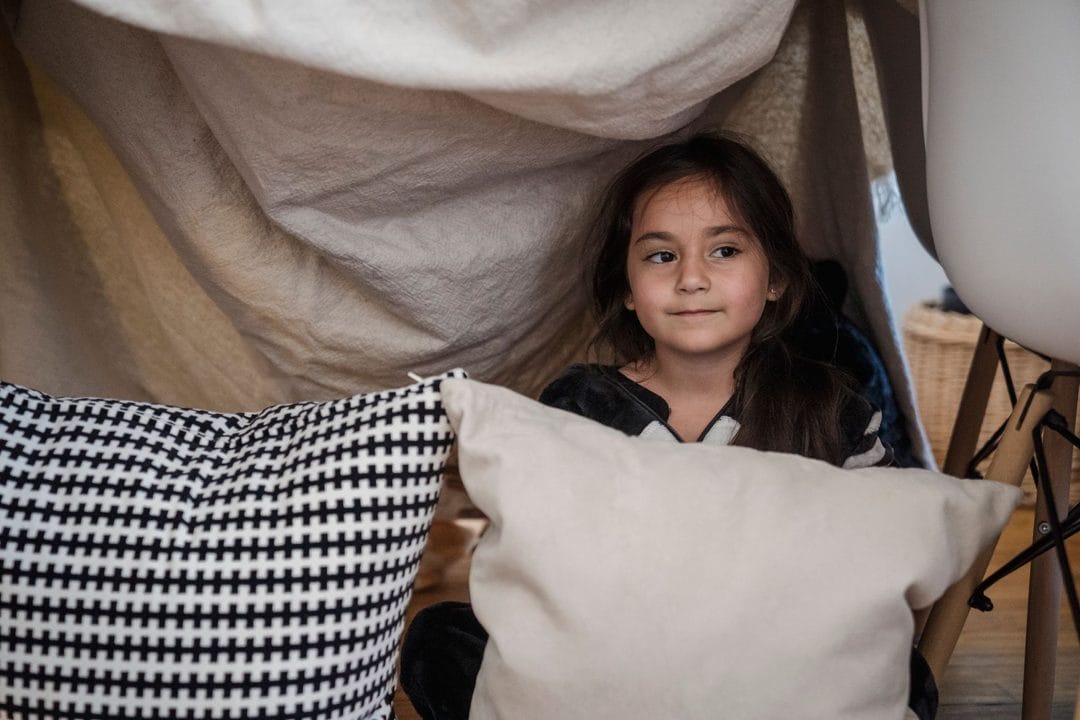
Three days into the holidays, my eight-year-old flopped face-down on the sofa and announced that life was over. Nothing to do. No one to play with. The tablet was charging and apparently that counted as a personal tragedy. I made a cup of tea, said "okay" with a shrug, and walked into the kitchen. Twenty minutes later he had built a fort out of sofa cushions and was running a pretend restaurant where the only dish was toast. I didn't fix his boredom. I just refused to rescue him from it, and that turned out to be the whole point.
Every summer the same pressure lands on parents like clockwork: keep them busy, keep them stimulated, keep them learning so the "summer slide" doesn't eat their reading age. Camps, clubs, activity packs, a colour-coded calendar that looks like a shift rota. The result is a lot of exhausted adults and children who can't sit with their own thoughts for ten minutes. There's a quieter, frankly easier option that most of us were raised on without realising it: let the summer be boring on purpose.
Why a boring summer is actually good for them
Boredom gets a terrible reputation, but it's the doorway to almost everything we say we want for our kids. When a child has nothing laid on for them, their brain stops consuming and starts generating. That cushion fort, the made-up board game with rules only they understand, the afternoon spent flipping a stick into a "fishing rod" by the back fence — none of that happens when the day is pre-packed with structured activities. Psychologist Lyn Fry, who has spent years arguing this point in British parenting circles, puts it bluntly: it's a parent's job to provide the conditions for play, not to fill every hour. Unstructured time is where children practise deciding what they want, which is a muscle no holiday club exercises.
There's also the matter of who owns the day. A child whose summer is a sequence of adult-organised events learns, subtly, that fun is something other people arrange and deliver. A child left to their own devices for stretches of the day learns the opposite — that they are the source of their own entertainment, and that a dull afternoon is a problem they can solve. That's resilience in its most ordinary form, and you can't buy it in a £180-a-week activity camp. The American Academy of Pediatrics has been saying for years that free play is central to healthy development, not a luxury to be squeezed in after the "real" enrichment.
None of this means abandoning your child to stare at a wall until they cry. The trick is the difference between boredom that has somewhere to go and boredom that's just neglect.
The "I'm bored" complaint, and how to actually respond
Here is the line every parent dreads, usually whined from a doorway: "I'm booooored." Your instinct is to either snap or scramble for a solution. Both are traps. Snap and you've made boredom a fight; scramble and you've taught them that the complaint summons an entertainment service staffed by you.
A better response is almost annoyingly calm. "Okay" is a complete sentence. So is "That's allowed." You're not being dismissive — you're handing the problem back to its rightful owner. If they push, you can offer the world's most boring menu: "You can read, draw, go outside, or help me peg out the washing." Suddenly inventing their own game looks fantastic by comparison. My favourite, stolen from a friend with four kids, is the deadpan: "Brilliant. Bored is where good ideas come from. Let me know what you make."
What you're protecting is the gap between the complaint and the invention. It can take a genuinely uncomfortable fifteen or twenty minutes — children will often complain louder before they settle, the way a fire crackles up before it catches. If you cave in that window, you never see what was on the other side of it. Hold the line once or twice and something shifts: they stop bringing the boredom to you because they've learned you're not going to take it.
Set up the house so play just happens
The laziest, most effective thing you can do is rig the environment so that play is the path of least resistance. This is the bit that actually takes effort, but you do it once and coast.
- Keep a "yes" cupboard or box: tape, scissors, old cereal boxes, string, junk-modelling bits, a stack of paper. Things they're allowed to use without asking. The asking is what kills momentum.
- Leave a few open-ended toys visible and the over-stimulating ones harder to reach. A pile of LEGO, some blocks, a basket of dressing-up clothes, and a roll of masking tape will out-perform almost any battery-powered gadget.
- Make outside easy: wellies by the door, a bucket, a magnifying glass, permission to get filthy. Mud is free and infinitely re-playable.
- Rotate, don't accumulate. Box up half the toys for a fortnight, then swap. An old toy reappearing feels brand new, and you've bought a week of novelty for nothing.
One genuinely useful trick when the whining peaks: a "boredom jar" with twenty or thirty slips of paper, each with a tiny prompt — build the tallest tower you can, write a letter to your future self, find five round things in the garden, invent a secret handshake. They draw one. Half the time they ignore it and do something else entirely, which is exactly the result you wanted. The jar isn't really an answer; it's a nudge that gets them past the sticky bit.
Where the boring-summer ideal meets real life
Now the honest part, because the wellness version of this advice always conveniently forgets that most parents have jobs. A free-range summer of unstructured play assumes an adult is loosely around, and for a lot of families that adult is on a work call until six. This is the genuine catch, and pretending otherwise is useless. Unstructured does not mean unsupervised, and a nine-year-old left alone for eight hours a day isn't building character, they're just lonely.
So the realistic shape is a mix. A couple of camp weeks or a holiday club to cover the gaps you can't, deliberately spaced out rather than back-to-back, and the rest left genuinely empty. The expensive multi-activity camps — the ones promising coding, archery and Mandarin in a single week — are usually the first thing to cut. Children remember the unstructured days far more fondly than the over-scheduled ones, and your bank account will thank you. In the UK a council-run holiday scheme often runs a fraction of the cost of a private camp; in the US a library summer reading programme or a YMCA day camp does the same job for far less than the boutique options; in Australia, vacation care through your existing OSHC provider is frequently subsidised in a way a standalone camp never is. Use the cheap, boring infrastructure and save the budget for the one trip everyone will actually remember.
And let go of the summer-slide panic while you're at it. The research on it is far shakier than the marketing for tutoring programmes would have you believe, and a child who spends August reading comics in a tent they built is not falling behind — they're doing childhood. A week of board games, library books, and being mildly bored will not undo a year of school.
What you're really giving them
The summer I remember most from my own childhood wasn't the one with the big holiday. It was the one where my brother and I spent six weeks largely ignored, inventing an elaborate ongoing game in the back garden that no adult ever fully understood. We were, by any modern standard, badly under-stimulated. We were also completely happy, and I'd give a lot to hand my own kids the same thing.
So when the doorway whining starts this year, try doing nothing. Not as a failure of effort, but as the effort. Make the tea, say "okay," and walk into the kitchen. The fort gets built on the other side of the boredom, not before it — and it was never your job to build it for them.